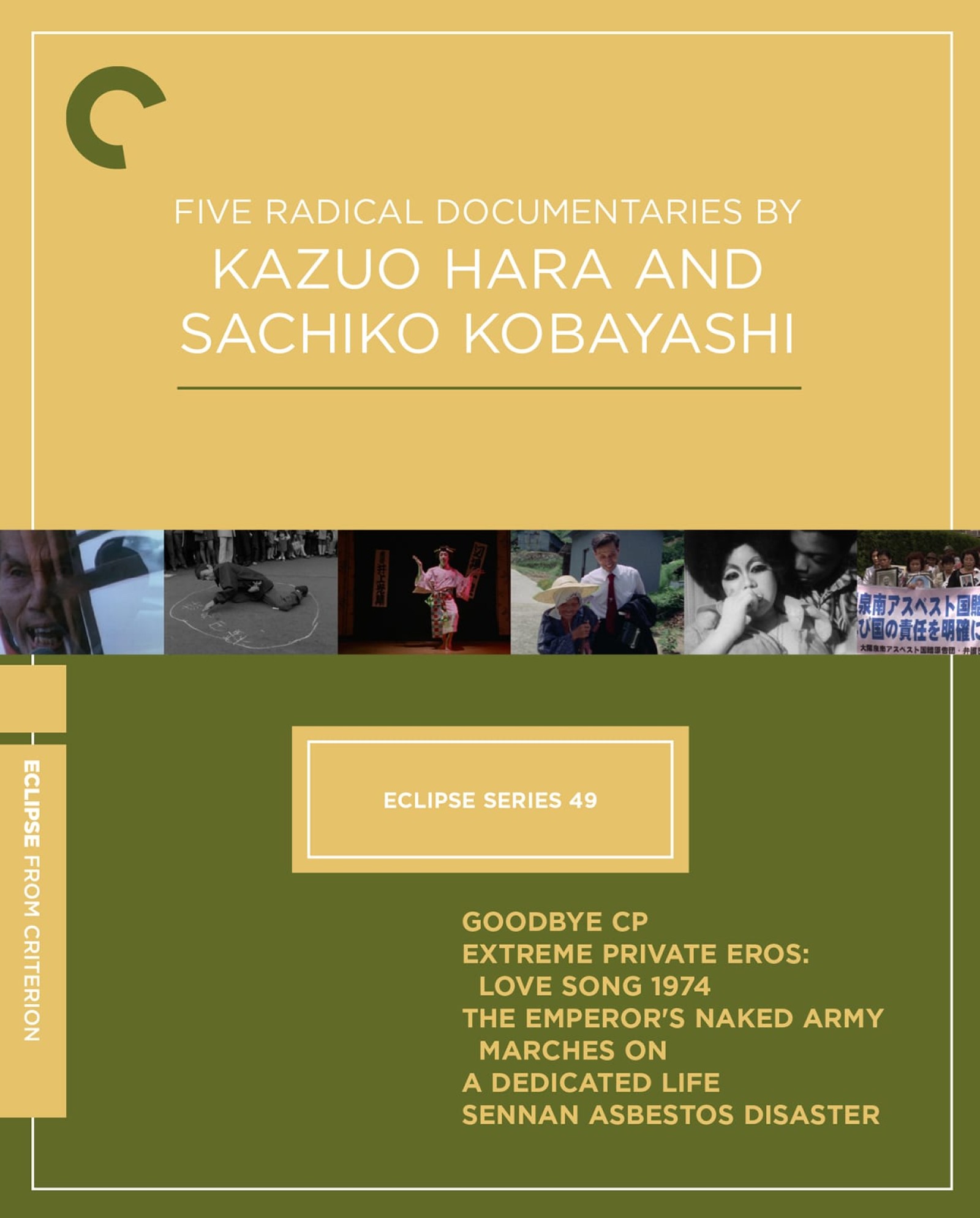
Five Radical Documentaries by Kazuo Hara and Sachiko Kobayashi
套装简介 / Synopsis
Shocking, confrontational, and made with white-hot fury, these radical documentaries—directed by Kazuo Hara and produced by his wife and longtime creative partner, Sachiko Kobayashi—give voice to the outsiders and iconoclasts who wage war against the conformism of modern Japanese society. From a woman willing to risk everything on her journey toward personal and sexual liberation (Extreme Private Eros: Love Song 1974) to a man whose quest to expose Japanese wartime atrocities borders on madness (The Emperor’s Naked Army Marches On), the unforgettable subjects of these films are invited to be collaborators in Hara and Kobayashi’s process, resulting in works of unmatched power and immediacy.
这些激进纪录片令人震惊、充满对抗性,以白热化的愤怒摄制而成——由原一男执导,其妻兼长期创作搭档小林佐智子制片——它们为那些与现代日本社会从众心理作战的局外人和反叛者发声。从一位愿为个人与性解放之路赌上一切的女性(《极端私人爱欲:1974 年情歌》,译名仅供参考),到一位揭露日本战时暴行的追索近乎疯狂的男子(《前进!神军》),这些影片中令人难忘的主人公被邀请成为原一男与小林佐智子创作过程中的合作者,最终成就了这些具有无与伦比的力量与即时性的作品。
影片明细 / Films in This Set(5 部)
再见CP Goodbye CP 1972
这部以同情与复杂笔触描绘残障人士经历的早期纪录片,是原一男炽热的导演处女作,也是关于何为局外人这一主题最毫不退缩的影片之一。与"青空会"(一群脑瘫活动家团体)合作制作,《再见CP》将成员们似乎西西弗斯式地把诉求带上街头的即兴拍摄素材,与 raw、有时带对抗性的访谈交织在一起——访谈中他们揭示了生活在一个对其存在残酷冷漠的社会中的痛苦。通过让拍摄对象成为影片的积极参与者(这一做法他将延续下去),原一男有力地伸张了那些长期被剥夺人性与自主权者的尊严。
An early documentary to portray the experiences of disabled people with compassion and complexity, Kazuo Hara’s searing debut is also one of the most unflinching films ever made about what it means to be an outsider. Produced in collaboration with the Green Lawn—a group of activists with cerebral palsy—Goodbye CP blends shot-on-the-fly footage of the members’ seemingly Sisyphean struggle to take their message to the streets with raw, sometimes confrontational interviews in which they reveal the torment of living in a society cruelly indifferent to their existence. In making his subjects active participants in the film—a practice he would continue—Hara powerfully asserts the humanity and agency of those who have long been denied both.
极端私色情:恋歌1974 Extreme Private Eros: Love Song 1974 1974
当他直言不讳的女权主义者前妻武田美由纪宣布要离开他去寻找自我时,原一男开始拍摄这部激进纪录片,既是为了维持他们复杂的关系,也是为了理解它。在新搭档小林佐智子的协助下,原一男获得了惊人的亲密权限,进入武田走向解放的任性旅程——她探索自己的性、成为单身母亲,并对传统社会结构日益失望。如同武田本人一样复杂而不妥协,《极端私色情:恋歌1974》打破了拍摄对象与导演之间的界限,刻画了一个愿意赌上一切按自己方式生活的女性。
When his first wife, the outspoken feminist Miyuki Takeda, announced that she was leaving him in order to find herself, Kazuo Hara began this radical documentary as a way both to maintain their complex relationship and to make sense of it. Assisted by his new partner, Sachiko Kobayashi, Hara is granted shockingly intimate access to Takeda’s wayward journey toward liberation, as she explores her sexuality, becomes a single mother, and grows increasingly disenchanted with traditional social structures. As complicated and uncompromising as Takeda herself, Extreme Private Eros: Love Song 1974 explodes the boundaries between subject and filmmaker to portray a woman willing to risk everything to live on her own terms.
天皇的赤裸军队行进 The Emperor’s Naked Army Marches On 1987
原一男最负盛名的影片是对日本历史最黑暗篇章之一的沉痛直面。在《天皇的赤裸军队行进》中,他令人难忘的拍摄对象兼合作者是奥崎谦三——一名前士兵、已决杀人犯、公然反体制的鼓动者——他把揭露二战期间日本军官在新几内亚对自己人犯下的罪行作为毕生使命。当奥崎谦三为查明真相诉诸极端手段时,浮现的既是一部令人震惊的调查新闻作品,也是对军国主义的勇敢谴责,更是一幅被近乎疯狂的原始愤怒驱使的偏执者的引人入胜肖像。
Kazuo Hara’s most renowned film is a harrowing confrontation with one of Japanese history’s darkest chapters. His unforgettable subject and collaborator in The Emperor’s Naked Army Marches On is Kenzo Okuzaki—a former soldier, convicted murderer, and defiantly antiestablishment agitator—who has made it his life’s mission to expose the crimes committed by Japanese officers against their own men in New Guinea during World War II. As Okuzaki resorts to extreme measures in his crusade to find out the truth, what emerges is at once a shocking piece of investigative journalism, a courageous condemnation of militarism, and a riveting portrait of a single-minded man driven by a raw fury bordering on madness.
奉献的人生 A Dedicated Life 1994
原一男对反叛主流社会的偶像破坏式人物的兴趣,引导他拍摄了《奉献的人生》——一部对有争议的小说家井上光晴的"墙上苍蝇"式肖像,他是战后日本时而迷人、时而好斗、常常令人沮丧的文学巨匠。然而,项目很快转向意想不到的方向:先是井上被诊断出晚期癌症,随后原一男发现这位作家的虚构甚至延伸到他自己人生的伪造细节中。当病弱的作者直面死亡时,原一男开始试图将人与神话分开,最终呈现出一个复杂人物的多层次肖像——他的人生是其艺术的延伸。
Kazuo Hara’s interest in iconoclastic figures living in opposition to mainstream society led him to work on A Dedicated Life, a fly-on-the-wall portrait of the controversial novelist Mitsuharu Inoue, a sometimes charming, sometimes combative, often frustrating literary lion of postwar Japan. The project, however, soon spins off into unexpected directions, first when Inoue is diagnosed with terminal cancer, then when Hara discovers that the writer’s fictions extend to the fabricated details of his own life. As the ailing author confronts his mortality, Hara begins trying to separate the man from the myth, resulting in a layered portrait of a complex figure whose life was an extension of his art.
泉南石棉灾 Sennan Asbestos Disaster 2016
这部历时十年拍成的史诗行动电影,记录了大阪泉南市民发起一场艰苦的法律诉讼,要求政府就他们暴露于该市石棉工厂致命毒素一事给予赔偿。通过对受害者令人痛心的访谈,《泉南石棉灾》勾勒出数十年疏忽造成毁灭性代价的令人谴责的画面,同时揭示这场悲剧如何与阶级问题及反韩歧视深度纠缠。这部关于集体行动力量的振奋之作,描绘了普通人在不懈争取正义的过程中,对抗冷漠、慢得令人发狂的官僚体制时所发生的一切。
Made over the course of ten years, this epic work of activist cinema joins the citizens of Sennan, Osaka, as they embark on an uphill legal battle to receive reparations from the government for exposing them to the deadly toxins of the city’s asbestos factories. Through wrenching interviews with the victims, Sennan Asbestos Disaster paints a damning portrait of how decades of negligence exacted a devastating toll while revealing how the tragedy is deeply entwined with issues of class and anti-Korean discrimination. This galvanizing look at the power of collective action depicts what happens when ordinary people go up against an unfeeling, maddeningly slow bureaucracy in their unceasing fight for justice.
特色功能 / Special Features
备注 / Note
重启蓝光套装